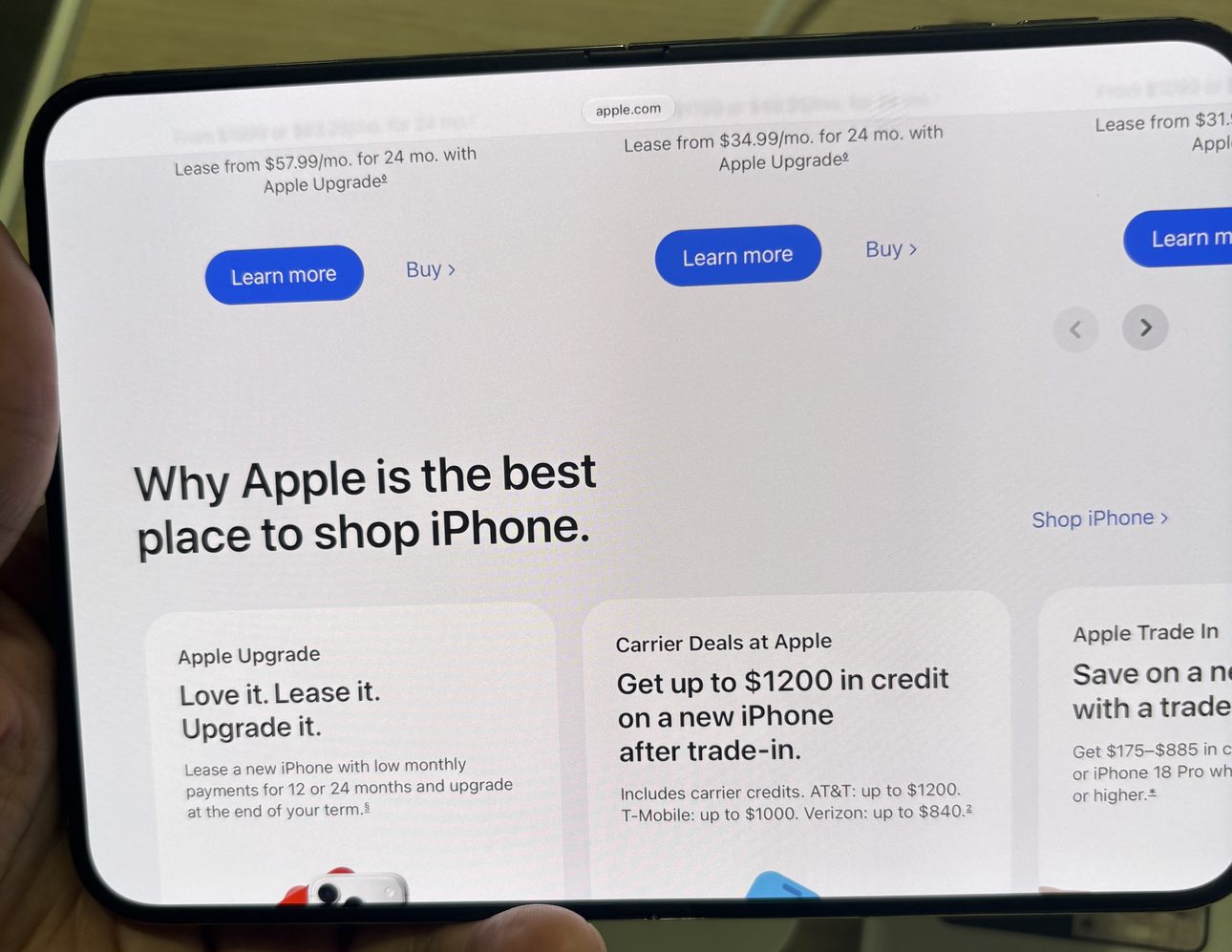
 Apple finally did it. After years of rumors, the iPhone Duo – Apple’s first foldable iPhone – went on sale on October 23, 2026, starting at $1,999. Yes, you read that correctly. TWO THOUSAND DOLLARS for the base model. With all the hype, you’d think I’d be first in line. Not this time. Read more to find out why I’m sitting this one out and waiting for the Duo 2.
I’m a firm believer in not buying the first version of anything. I try not to get the latest and greatest, because I prefer the newest tech products to be out in the marketplace for awhile and get all the kinks knocked out of them before I take the plunge and pay for them. That goes double for a brand-new product category with a hinge, a folding screen, and a price tag that costs more than some used cars. Basically, the first-gen Duo has to prove itself to me.
To be fair, the reviews have been mostly positive. BGR called it “the first foldable phone I’d actually switch to.” But almost every reviewer has the same list of complaints, and they happen to match my own concerns. Let’s get to it.
WHY FIRST-GEN FOLDABLES MAKE ME NERVOUS
If you don’t remember, Samsung’s very first Galaxy Fold back in 2019 was a mess. Some of the review units broke within days, because reviewers peeled off what looked like a screen protector, but was actually part of the screen. Others had debris get into the hinge and damage the display. Samsung had to delay the launch by several months to fix it. Each new Fold since then has gotten thinner, lighter, and tougher, and that’s exactly my point. The first version of a foldable is where the company learns its lessons – on its customers’ dime.
Apple waited much longer than Samsung, Google, and the others to release its first foldable, and I’m sure it learned from their mistakes. But a folding screen is still a folding screen, and a hinge is still a moving part. There’s only so much you can test in a lab before real people start using it every day.
THE SPECS
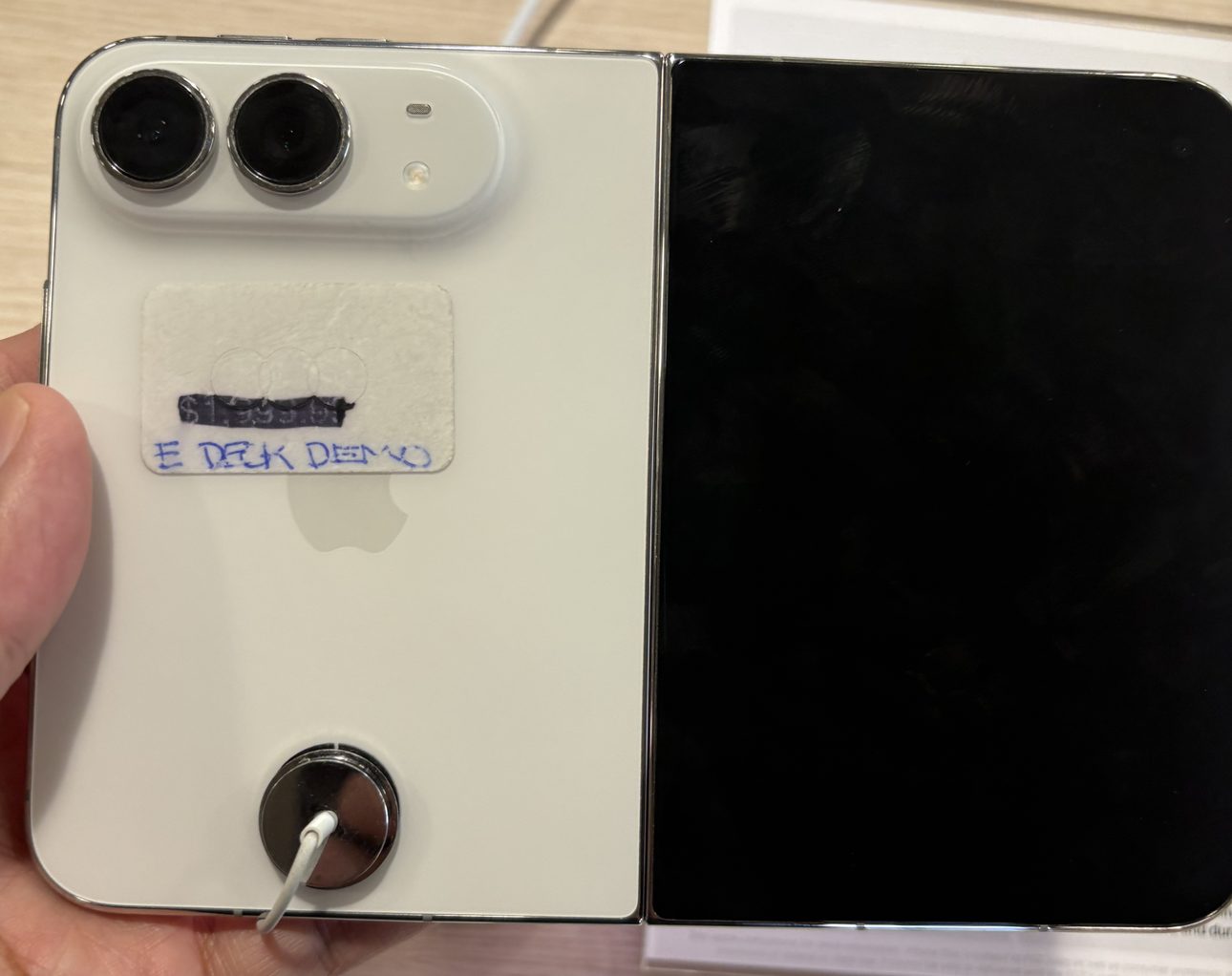
Here are the iPhone Duo specs, as announced by Apple on September 9, 2026:
- Price. $1,999 (256GB), $2,199 (512GB), $2,599 (1TB), $3,199 (2TB). Whoa!
- Inner display. 7.6-inch LTPO OLED, 2670 x 1878, 120Hz, up to 3,000 nits peak brightness, with a matte “nano-texture” finish to hide the crease.
- Outer (cover) display. 5.4-inch LTPO OLED, 2034 x 1398, 120Hz – basically the size of the old iPhone mini.
- Chip. A20 Pro (2nm) with 12GB of RAM.
- Rear cameras. 48MP main (f/1.6, sensor-shift OIS) and 48MP ultrawide. No telephoto.
- Front cameras. 12MP on the cover screen and a 4MP under-display camera on the inner screen.
- Security. Touch ID in the power button. No Face ID.
- Battery. 4,883 mAh (split into two cells). Apple claims up to 24 hours of mixed use.
- Charging. USB-C (50% in 20 minutes with a fast charger) and 25W MagSafe/Qi2. No charger in the box.
- Size. 11.3mm thick folded, 5.2mm thick unfolded.
- Weight. 254 grams (about 9 ounces).
- Build. Titanium frame and hinge, Ceramic Shield 2 on the cover screen, IP68 water and dust resistance.
- Colors. Night Sky and Star White.
For comparison, the iPhone 18 Pro Max starts at $1,299 and weighs 249 grams. Samsung’s Galaxy Z Fold 8 costs $100 less than the Duo and weighs only 201 grams.
WHAT APPLE GOT RIGHT
Before I get to my concerns, credit where credit is due. Apple waited years to enter the foldable market, and in some areas, it shows.
Pros:
- The hinge is a work of art. It uses over 100 parts and holds any angle from 15 to 165 degrees, so you can stand it up like a tiny laptop or a tent on the table. Closing it is smooth and satisfying. Apple has always been good at this kind of engineering, and the hinge is where most foldables cut corners.
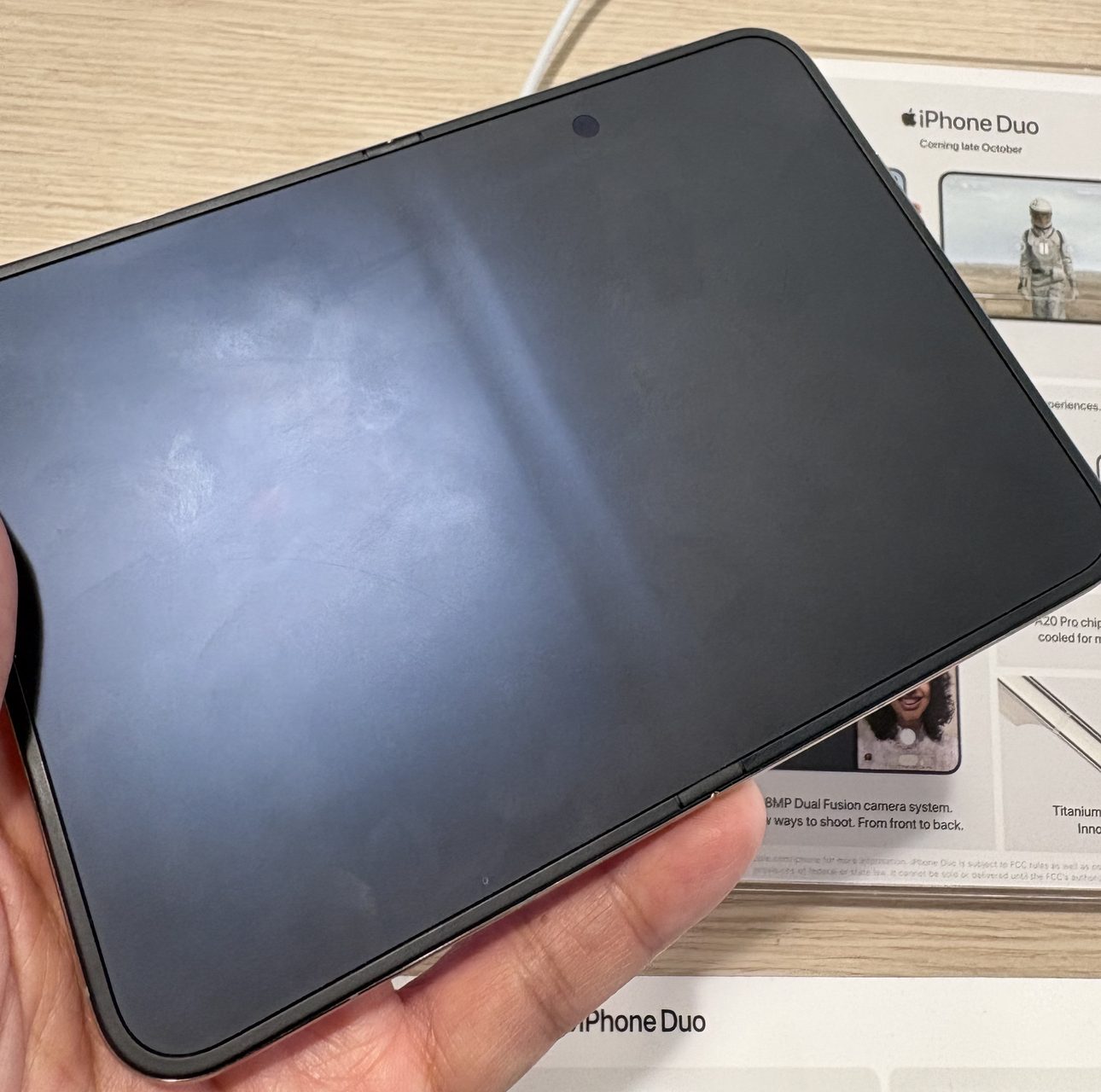
- The crease is hard to see (for now). Reviewers say that when you look at the inner screen straight on, the crease is almost invisible, and most can’t feel it with a thumb. The matte nano-texture coating scatters light so the crease doesn’t jump out at you. It still catches the light at an angle, especially on dark screens.
- Two great screens. The 7.6-inch inner screen is basically an iPad mini in your pocket. The 5.4-inch cover screen is a usable phone screen on its own, not a skinny strip like some early foldables.
- Plenty of power. The A20 Pro chip with 12GB of RAM is the fastest chip Apple makes for a phone. I don’t see it slowing down anytime soon.
- IP68 water resistance. For a phone with a hinge, this is impressive. Most foldables have struggled with dust and water, and Apple rates the Duo the same as the regular iPhones.
MY CONCERNS
Now to the good stuff. Here’s why my credit card is staying in my wallet.
Cons:
- Will the crease get more noticeable over time? This is my biggest worry. A brand-new Duo looks great, but what about after a year of opening and closing it? HTX Studio, a YouTube channel that tests foldables, measured the crease on a new Duo at 48 microns deep. After 3,000 folds, it was 167 microns – more than three times deeper. That may still be hard to see, but think about it: if you open and close your phone 30 times a day, you’ll hit 3,000 folds in a little over three months. Where will the crease be after two or three years? Nobody knows yet, because the phone has only been out for a week. When you pay $2,000 for a phone, you expect it to look like a $2,000 phone for a long time.
- The screen cracking reports. Within days of launch, some owners in the U.S., China, and Australia started posting photos of inner screens cracking along the hinge, some with a bright white line down the screen. One Australian owner said it happened after six hours of use and fewer than 20 openings. On October 26, Apple acknowledged an issue with the inner display on “a small number of units” and is replacing them through AppleCare. To be fair, early reports on social media always make problems sound bigger than they are. But it doesn’t give me the warm and fuzzies either. On top of that, in a durability test by the YouTube channel JerryRigEverything, dust got into the hinge, and a bend test left a permanent green line on the inner screen before the display stopped responding. Bend tests are extreme, but still – yikes.
- Will the weight get annoying? At 254 grams, the Duo is the heaviest iPhone Apple has ever made. That’s heavier than the iPhone 18 Pro Max (249g), the Pixel 11 Pro Fold (239g), and much heavier than the Galaxy Z Fold 8 (201g). It’s also 11.3mm thick when folded, which is like stacking two phones together. Reviewers say it’s not a big deal coming from a Pro Max, but it does feel heavy in one hand when folded. My worry is the long run. Holding 9 ounces up to your face while reading in bed or on a long flight is a recipe for a tired wrist. And it’s going to make a noticeable bulge in your pocket. A phone you leave at home because it’s too heavy is not a phone you’ll love. One more thing: the hinge uses magnets to keep it closed, so reviewers say opening it is usually a two-handed job. Not a big deal at your desk, but annoying when you’re holding a coffee in the other hand.
- No Face ID. Apple went with Touch ID in the power button instead. Reviewers say it works fine once you get used to it, but they all miss Face ID. With Face ID, you just look at the phone and it unlocks, shows your notifications, and pays at the register. With Touch ID, you have to find the button first, and it doesn’t work well with gloves. After years of Face ID, going back to a fingerprint sensor on a $2,000 phone feels like a step backwards. Ugh.
- The cameras are a step below the Pro iPhones. Two 48MP cameras on the back, and that’s it. There’s no telephoto lens. You get a decent 2x zoom, but at 10x the pictures get soft and mushy. Reviewers compare the photos to the regular iPhone 17, not the iPhone 18 Pro. The inner selfie camera is only 4MP and is fine for video calls, but that’s about it. For the most expensive iPhone ever made, you would expect the best cameras Apple has, not the leftovers.
- Apps aren’t ready yet. Apple’s own apps like Mail and Messages look great on the big screen. But a lot of other apps just show a lot of empty black space, and reviewers mentioned Google Maps and Google Docs among the apps that aren’t optimized yet. Split View only lets you run two apps side by side, locked at 50/50. On an iPad-sized screen, I would expect more. One reviewer also noticed that the on-screen keyboard can cover your FaceTime video in split view. Doh!
- Repairs are expensive. If you break the inner screen outside of warranty, it’s $999 to fix. Other damage, likely including the hinge, is $1,499. Even with AppleCare+, an inner screen repair is $99. iFixit gave the Duo a repairability score of only 5 out of 10. Bottom line – if you buy the Duo, get AppleCare+.
- Battery life is good, not great. Apple claims up to 24 hours of mixed use, and reviewers are getting through a full day. But the iPhone 18 Pro Max is rated for up to 45 hours of video playback compared to the Duo’s 31 hours on the inner screen. Big screens eat battery.
WHAT I WANT IN THE DUO 2
Apple usually gets it right by the second or third version. The first iPhone didn’t have 3G or an App Store. The first Apple Watch was slow and needed your iPhone for almost everything. So here’s my wish list for the iPhone Duo 2:
- Face ID. This is #1 on my list. According to Bloomberg’s Mark Gurman, Apple has already tested Duo prototypes with Face ID built under the cover screen. It may not be ready until the 2nd or 3rd generation, but I’m willing to wait.
- Better cameras. Add a real telephoto lens – at least 3x or 5x optical zoom – and bring the main camera up to Pro level. If I’m paying Pro Max money and then some, I want Pro Max cameras.
- Lose some weight. Get it closer to 200 grams, like Samsung did with the Z Fold 8. Even 20-30 grams would make a difference in your hand and in your pocket.
- A crease that stays put. I want proof, from long-term testing, that the crease doesn’t get worse after a year or two of normal use. A durability rating for the number of folds would be nice too.
- Better multitasking. Let me run three apps, resize the windows, and drag apps from the home screen into Split View. This screen is too big to treat like a regular iPhone.
- A lower price. I know, I know – this is Apple. But $1,999 for the base model is a lot to ask, especially when the Pro Max costs $700 less and has better cameras and Face ID. Even a $200 drop would make it a much easier decision.
By the time the Duo 2 comes out, more apps should be optimized for the big screen too. That alone is a good reason to wait.
WHO SHOULD BUY IT (AND WHO SHOULDN’T)
In my opinion, the first-gen Duo makes sense for a small group of people:
- Heavy readers and video watchers. If you read e-books, news, or PDFs on your phone every day, or watch a lot of video, the 7.6-inch screen is a real upgrade.
- Frequent business travelers. If you carry both a phone and an iPad mini on trips, the Duo can replace both. That’s one less device and one less charger in your bag.
- Early adopters with deep pockets. If you always want the newest thing and can afford a $2,000 phone plus AppleCare+, you’ll enjoy it.
On the other hand, I would skip it if you take a lot of photos (especially zoomed-in shots at sports games or concerts), if you mostly use your phone with one hand, if you love Face ID, or if you’re on a budget. You’ll be happier with an iPhone 18 Pro or Pro Max.
MY VERDICT
Don’t get me wrong – I think the iPhone Duo is an impressive first try. The hinge, the screens, and the build quality are what you’d expect from Apple. If you have the budget, love being an early adopter, and want an iPad mini that fits in your pocket, go for it. Just get AppleCare+, and keep an eye on that crease.
But for most people, myself included, the iPhone 18 Pro or Pro Max is the smarter buy right now. You get better cameras, Face ID, longer battery life, and a phone that weighs less, for a lot less money. As a traditionalist, I can wait one more year for Apple to work out the kinks.
On paper, I would give the first-gen iPhone Duo 3.5 out of 5 stars. Ask me again when the Duo 2 comes out. Hopefully, it’s the foldable I’ve been waiting for. 😉